

Attested OGBA-101 Dumps PDF Resource [2026]
Latest OGBA-101 Actual Free Exam Questions Updated 130 Questions
NEW QUESTION # 52
Which of the following is the element of a value stream stage that describes the state change that triggers the value stream stage?
- A. Baseline state
- B. Enhance criteria
- C. Gating stage
- D. Starting point
Answer: C
Explanation:
In the context of value stream stages, a gating stage is the element that describes the specific state change which triggers the next stage of the value stream to begin. It acts as a checkpoint that ensures that certain criteria are met before the process can proceed to the next phase.
NEW QUESTION # 53
Complete the sentence A business capability is_________________________________.
- A. a description of the architectural approach to realize a particular business solution
- B. a representation of an end-to-end collection of business activities
- C. an ability that a business possesses to achieve a specific outcome
- D. a qualitative statement of intent that should be met by the business architecture
Answer: C
Explanation:
A business capability is a conceptual representation that reflects the core abilities or capacities of a business. It is defined as an intrinsic ability that an organization possesses or can develop to consistently deliver a specific outcome or set of outcomes. Business capabilities abstract away from the organizational structure, processes, and technology to focus on the 'what' the business can do, rather than the 'how' it does it. This concept is fundamental in business architecture as it helps in aligning strategic objectives with operational efficiency.
NEW QUESTION # 54
Which of the following is a benefit of Value Stream Mapping?
- A. It helps to ensure that investments and project initiatives are prioritized and funded at a level matching with their value.
- B. It helps to identify value, duplication, and redundancy across the enterprise.
- C. It helps to assess an organization's effectiveness at creating, capturing, and delivering value for different stakeholders.
- D. It highlights the value of individual work packages needed to develop the business architecture.
Answer: C
Explanation:
One of the benefits of Value Stream Mapping is that it helps to assess an organization's effectiveness at creating, capturing, and delivering value for different stakeholders2. Value Stream Mapping is a technique that can be used to represent a sequence of activities that create an overall result for a customer, stakeholder, or end user2. Value Stream Mapping can help to identify the value proposition, outcomes, measures, enablers, and dependencies of each activity in the value stream, as well as the overall value flow and performance2. By analyzing the value stream map, the organization can evaluate how well it is meeting the stakeholder needs and expectations, as well as identify opportunities for improvement or innovation.
NEW QUESTION # 55
Which of the following describes how business models are used within the TOGAF standard?
- A. To tailor the enterprise architecture for the business.
- B. To document the factors impacting the business migration plan.
- C. To help formulate architecture and business principles.
- D. To identify, classify, and mitigate risks to the business.
Answer: C
Explanation:
Business models are used within the TOGAF standard to help formulate architecture and business principles4. A business model describes how an organization creates, delivers, and captures value for its stakeholders4. A business model can help to define the strategic direction, goals, and objectives of the organization, which can then inform the development of architecture and business principles that guide the design and evolution of the enterprise architecture.
NEW QUESTION # 56
Which of the following best describes why business model innovation should be approached in a structured manner?
- A. To ensure that changes to business models can interact with the existing architecture.
- B. To adapt to changes in the organization structure to meet a new market need.
- C. To provide a consistent and measurable level of quality information to decision-makers.
- D. To enable the business to thrive in a state of constant motion.
Answer: A
Explanation:
Business model innovation involves making significant changes to how an organization creates, delivers, and captures value. These changes can be disruptive and have far-reaching implications for the entire enterprise. A structured approach to business model innovation is essential to:
* Maintain alignment with enterprise architecture: A structured approach ensures that new business models are compatible with the existing technology, data, and application architecture.
This prevents costly rework, integration issues, and disruptions to existing operations.
* Minimize risk and disruption: By carefully considering the impact of changes on different parts of the organization, a structured approach helps to mitigate risks and avoid unintended consequences.
* Facilitate effective decision-making: A structured approach provides a framework for evaluating different business model options and making informed decisions based on clear criteria and analysis.
* Enable smooth transition: A structured approach helps to manage the transition to the new business model, ensuring a smooth implementation and minimizing disruptions to customers and employees.
NEW QUESTION # 57
Which of the following is a purpose of mapping capabilities to value stream stages?
- A. To provide a self-contained business description that is independent of the organizational structure.
- B. To describe the business in terms of services provided and consumed.
- C. To identify and eliminate business capabilities that do not contribute to the business.
- D. To classify, group, and align capabilities into categories for a deeper understanding.
Answer: C
Explanation:
The purpose of this activity is to identify which business capabilities (out of the total set of capabilities) are critical to delivering stakeholder value, and therefore which ones need to be performed to a sufficient standard of quality to meet stakeholder expectations. It also helps to identify those business capabilities that do not contribute toward any of the core value streams, and which may be eliminated from the business.
The primary purpose of mapping capabilities to value stream stages within the TOGAF framework is to analyze how each capability contributes to delivering value to the customer. This process helps to identify:
* Capabilities essential for value creation:These are the capabilities that directly contribute to the activities within the value stream and are critical for delivering customer value.
* Capabilities with indirect or unclear contributions:These may require further investigation to determine their role in the value stream.
* Non-contributing capabilities:These capabilities do not play a role in the value stream and may be candidates for elimination or optimization to improve efficiency and reduce costs.
NEW QUESTION # 58
Consider the following statements:
Groups of countries, governments, or governmental organizations (such as militaries) working together to create common or shareable deliverables or infrastructures Partnerships and alliances of businesses working together, such as a consortium or supply chain What are those examples of according to the TOGAF Standard?
- A. Business Units
- B. Architectures Scopes
- C. Organizations
- D. Enterprises
Answer: D
Explanation:
TOGAF defines an "Enterprise" as any collection of organizations or alliances working toward shared goals, such as in consortiums or partnerships. This scope allows the architecture to address cross-organization processes and infrastructures for collaborative endeavors.
Reference:
TOGAF defines an Enterprise as any collection of organizations that has a common set of goals. This definition is intentionally broad and can encompass various types of entities, including:
Single organizations: A traditional company or corporation with a unified structure and goals.
Groups of organizations: This could include:
Public sector: Government agencies, military branches, or international collaborations like the United Nations.
Private sector: Consortiums, industry alliances, supply chains, or joint ventures where multiple businesses work together towards shared objectives.
The key characteristic of an enterprise is the shared set of goals that drives its activities and architecture.
NEW QUESTION # 59
When developing a Business Architecture, which of the following is recommended if an enterprise has existing Architecture Descriptions?
- A. They should be used as the basis for the Baseline Description.
- B. They should be used to validate the business principles.
- C. They should be added to the Governance Repository within the Architecture Repository.
- D. They should be reviewed, and work packages identified for portfolio planning.
Answer: A
Explanation:
When developing a Business Architecture, TOGAF provides guidance on how to leverage existing architecture descriptions to build a comprehensive and accurate Baseline Description. Here's a step-by-step explanation:
Existing Architecture Descriptions:
Existing architecture descriptions provide valuable insights into the current state of the enterprise's architecture. These descriptions can include documentation of processes, systems, technologies, and organizational structures.
Baseline Description:
The Baseline Description represents the current state of the enterprise architecture. It serves as the starting point for developing the Target Architecture and planning the transition from the current state to the future state.
Using Existing Descriptions:
Review and Analyze: Existing architecture descriptions should be reviewed and analyzed to understand the current state accurately. This involves identifying all relevant artifacts, documents, and data.
Integration into Baseline: The information from the existing descriptions should be integrated into the Baseline Description. This ensures that the Baseline accurately reflects the current state, providing a solid foundation for future planning.
Gaps and Opportunities: By using existing descriptions, architects can identify gaps in the current architecture and opportunities for improvement. This helps in formulating a more effective Target Architecture.
TOGAF ADM Reference:
Phase A: Architecture Vision: This phase involves establishing the architecture vision, which includes defining the scope and approach for the Baseline Description.
Phase B: Business Architecture: During this phase, the Baseline Business Architecture is developed using existing architecture descriptions as a key input.
In summary, using existing architecture descriptions as the basis for the Baseline Description ensures that the current state is accurately documented, providing a reliable foundation for developing the Target Architecture and planning the transition.
NEW QUESTION # 60
In the diagram, what are the items labelled A, B, and C?
- A. A-Architecture Repository, B-Governing Board, C-Enterprise Capability
- B. A-Architecture Repository, B-Governance Repository. C-Architecture Capability
- C. A-Enterprise Repository, B-Governance Repository. C-Board Repository
- D. Enterprise Repository, B-Board repository, C-Enterprise Capability
Answer: A
Explanation:
In the provided diagram, item A refers to the Architecture Repository, which is a part of the TOGAF framework where all the architecture assets are stored. This includes the architectural models, patterns, architecture descriptions, and other artifacts relevant to the architecture. Item B is labeled as the Governing Board, which is likely referring to the Architecture Board or a similar governance structure responsible for oversight and decision-making regarding the enterprise architecture. Item C refers to Enterprise Capability, which encompasses the processes, tools, skills, and other capabilities that enable the architecture function within the enterprise.
NEW QUESTION # 61
Complete the sentence. The four dimensions used to scope an architecture are:
- A. Breadth, Depth, Time Period, Architecture Domains
- B. Business, Data, Application, Technology
- C. Strategy, Portfolio, Project, Solution Delivery
- D. Strategy, Segment, Capability, Budget
Answer: A
Explanation:
In TOGAF, the dimensions for scoping an architecture are Breadth (coverage across the organization), Depth (level of detail), Time Period (horizon of the architecture), and Architecture Domains (the four architecture domains of Business, Data, Application, and Technology). These dimensions ensure comprehensive scoping and contextual alignment.
References: TOGAF Standard, Chapter on Scoping the Architecture.
According to TOGAF, defining the scope of an architecture involves considering these four key dimensions:
* Breadth:This refers to how much of the enterprise is covered by the architecture. It defines the boundaries of the architecture, which could range from a single department to the entire organization, or even extending to external partners.
* Depth:This dimension determines the level of detail included in the architecture. It can range from high- level conceptual models to detailed specifications of individual components.
* Time Period:This specifies the timeframe for the architecture, including the intended lifespan of the architecture and any planned phases or iterations. It addresses questions like "What is the architecture for now?" and "What should the architecture look like in the future?"
* Architecture Domains:This dimension defines which of the four architecture domains (Business, Data, Application, Technology) are included in the scope. The selection of domains depends on the specific needs and objectives of the architecture development effort.
NEW QUESTION # 62
In the diagram, what are the items labelled A, B, and C?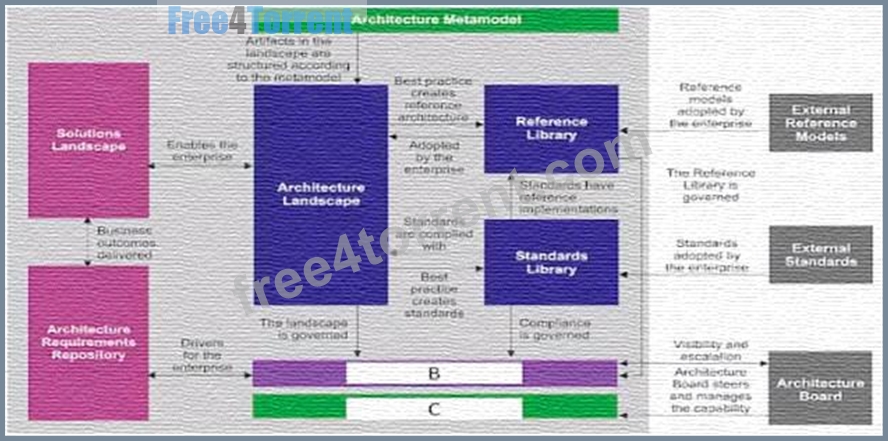
- A. A-Architecture Repository, B-Governing Board, C-Enterprise Capability
- B. A-Architecture Repository, B-Governance Repository. C-Architecture Capability
- C. A-Enterprise Repository, B-Governance Repository. C-Board Repository
- D. Enterprise Repository, B-Board repository, C-Enterprise Capability
Answer: A
Explanation:
In the provided diagram, item A refers to the Architecture Repository, which is a part of the TOGAF framework where all the architecture assets are stored. This includes the architectural models, patterns, architecture descriptions, and other artifacts relevant to the architecture. Item B is labeled as the Governing Board, which is likely referring to the Architecture Board or a similar governance structure responsible for oversight and decision-making regarding the enterprise architecture. Item C refers to Enterprise Capability, which encompasses the processes, tools, skills, and other capabilities that enable the architecture function within the enterprise.
NEW QUESTION # 63
In business capability mapping, when you have documented all of the business capabilities, what should you do next?
- A. Organize the business capabilities in a logical manner.
- B. Identify the human and computer actors associated with each business capability.
- C. Draw up a business value assessment for each of the business capabilities.
- D. Map the business capabilities to stakeholder concerns.
Answer: A
Explanation:
According to the TOGAF Series Guide: Business Capabilities, after documenting all of the business capabilities, the next step is to organize them in a logical manner1. This can be done by using techniques such as layering, sorting, mapping, and leveling1. These techniques can help to classify, group, and align capabilities into categories for a deeper understanding of how they support the business goals and objectives1. Organizing the business capabilities can also help to identify dependencies, gaps, overlaps, or redundancies among them1.
NEW QUESTION # 64
What criteria for a good architecture principle Indicates that it is sufficiently definitive and precise to support consistent decision-making in complex situations?
- A. Robustness
- B. Completeness
- C. Stability
- D. Consistency
Answer: A
NEW QUESTION # 65
In what TOGAF ADM phase is the information map linked to other business blueprints?
- A. Preliminary Phase
- B. Phase A
- C. Phase E
- D. Phase B
Answer: C
Explanation:
Phase E Explanation of Correct answer: In Phase E (Opportunities and Solutions) of the TOGAF Explanation:ADM, the information map is linked to other business blueprints such as the Business Capability Map, the Value Stream Map, and the Business Process Model Phase E Explanation of Correct answer: In Phase E (Opportunities and Solutions) of the TOGAF Explanation:ADM, the information map is linked to other business blueprints such as the Business Capability Map, the Value Stream Map, and the Business Process Model2. This helps to identify and prioritize opportunities for business improvement and transformation2.
NEW QUESTION # 66
Refer to the table below: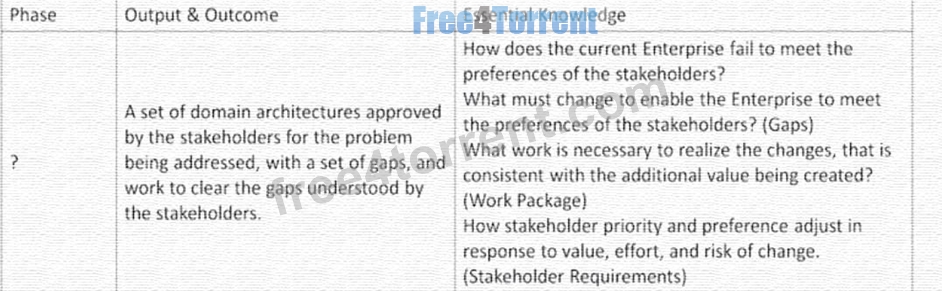
Which ADM Phase(s) does this describe?
- A. Preliminary Phase
- B. Phase B. C and D
- C. Phase E
- D. Phase B
Answer: B
Explanation:
The table describes the steps involved in Phase B (Business Architecture), Phase C (Information Systems Architectures), and Phase D (Technology Architecture) of the TOGAF ADM5. These phases are responsible for developing the target architectures for each domain and identifying the gaps between the baseline and target architectures. The table shows the outputs and outcomes of each phase, as well as the essential knowledge required for each phase.
NEW QUESTION # 67
In the ADM, what is the name for a document deliverable that has completed a review and is approved?
- A. final
- B. approved
- C. version 0.9
- D. ratified
Answer: D
NEW QUESTION # 68
Consider the following extract of a model showing relationships between Business Architecture concepts: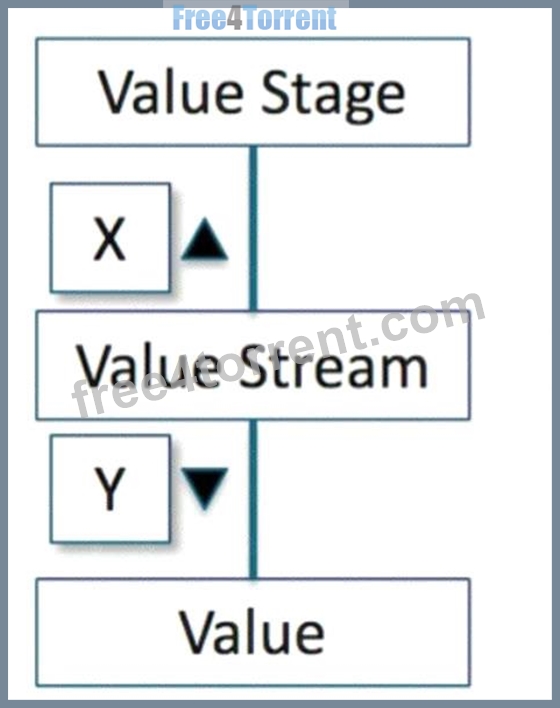
What is the relationship labeled X?
- A. Receives
- B. Enables
- C. Creates
- D. Consists of
Answer: D
Explanation:
In the context of TOGAF and Business Architecture, the diagram depicts the relationship between a Value Stream, Value Stage, and Value.
* Value Stream: Represents the end-to-end set of activities that create and deliver value to a stakeholder.
* Value Stage: A distinct step or phase within the Value Stream.
* Value: The benefit delivered to the stakeholder.
The relationship "X" indicates that a Value Stream is composed of multiple Value Stages.
Think of it like a journey (Value Stream) with multiple stops along the way (Value Stages). Each stage contributes to the overall value delivered at the end of the journey.
NEW QUESTION # 69
Which of the following best describes this diagram?
- A. Business Relationships diagram
- B. Business Capabilities Layer diagram
- C. Business Capability/Value Stream Mapping
- D. Business Capability Map
Answer: D
Explanation:
The diagram presented is best described as a Business Capability Map. Here's a detailed explanation:
Business Capability Map:
Definition: A Business Capability Map represents the various capabilities an organization requires to deliver its products and services and achieve its strategic objectives. It typically categorizes capabilities into different levels or tiers, such as strategic, core, and supporting capabilities.
Diagram Analysis:
Layers and Groupings: The diagram shows capabilities grouped into three categories: Strategic, Core, and Supporting. Each group lists specific business capabilities necessary for the organization's functioning.
Color Coding: The use of different colors (green, red, yellow, purple) may indicate various aspects such as priority, status, or different business units. However, the primary purpose is to visually represent and categorize capabilities.
TOGAF Reference:
Phase B: Business Architecture: In this phase, creating a Business Capability Map is a crucial activity. It helps in understanding the business functions and aligning them with strategic goals.
Capability-Based Planning: TOGAF promotes capability-based planning, which involves identifying, mapping, and analyzing business capabilities to ensure they support the overall strategy and objectives.
Purpose and Benefits:
Strategic Alignment: The Business Capability Map helps in aligning business capabilities with the strategic objectives of the organization. It provides a clear view of what the organization needs to do to achieve its goals.
Gap Analysis: It is useful for conducting gap analysis by comparing current capabilities with the desired state, helping to identify areas for improvement.
Resource Allocation: By understanding the different capabilities, organizations can allocate resources more effectively to areas that need development or enhancement.
In summary, the diagram is best described as a Business Capability Map because it visually represents and categorizes the various capabilities needed by the organization into strategic, core, and supporting layers, aligning them with the business strategy and objectives.
NEW QUESTION # 70
Which of the following can be used to help define information concepts in an information map?
- A. Stakeholder Map
- B. Organization Map
- C. Statement of business goals and drivers
- D. Value streams
Answer: A
Explanation:
* Role of Information Maps in TOGAFInformation maps are used to define and structure the key information concepts necessary for an organization's operations. They organize information in a way thataligns with the organization's business needs and are crucial for creating a robust information architecture.
* Relationship Between Information Maps and Stakeholder MapsIn TOGAF and enterprise architecture practices, stakeholder maps play an essential role in defining information concepts because they identify the various stakeholders involved in or affected by the business operations. Understanding stakeholders and their interactions helps architects determine the types of information that are valuable to each stakeholder group. This understanding aids in structuring the information map to meet the specific needs and requirements of each stakeholder.
As per TOGAF guidance, if an organization already has a stakeholder map, it can serve as a valuable tool for identifying the information concepts required by different stakeholders. This allows architects to tailor the information architecture to align with the interests, roles, and responsibilities of stakeholders, which directly impacts the organization's information needs.
* Why Stakeholder Map is the Correct Answer
* Stakeholder maps provide insights into the information needs of various stakeholders, helping to define information concepts within the information map.
* By referencing a stakeholder map, architects can identify the key information flows, data requirements, and access needs of each stakeholder, ensuring that the information map is comprehensive and aligned with actual usage.
* This alignment with stakeholder needs ensures that the information architecture supports the organization's objectives by delivering relevant information to each party involved.
* Why Other Options are Less Suitable:
* Option B (Value Streams):Value streams focus on the high-level flow of activities that deliver value but do not directly inform the structure of information concepts.
* Option C (Statement of Business Goals and Drivers):While business goals and drivers provide strategic direction, they do not specifically define information concepts in the same way that understanding stakeholder needs does.
* Option D (Organization Map):An organization map helps in understanding roles and responsibilities within the enterprise but does not directly influence the definition of information concepts in the same manner as a stakeholder map.
Conclusion:
The correct answer isA. Stakeholder Mapbecause it directly helps define information concepts in an information map by clarifying the information needs of each stakeholder group.
References:
* TOGAF Standard, Version 9.2, Stakeholder Mapping and Information Mapping Techniques
* TOGAF Business Architecture Guide, sections on Information Maps and Stakeholder Maps
NEW QUESTION # 71
Consider the following business capability map. where cells of a model are given different colors to represent desired maturity levels (Green (G) = level achieved, yellow (Y) = one level away, red (R) =two or more levels away, purple (P) = missing capability):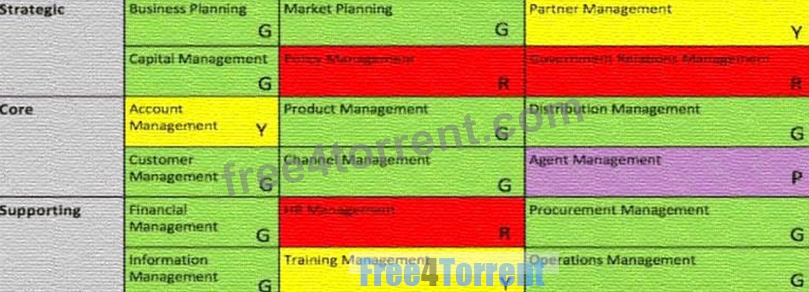
Which of the following best describes what this shows?
- A. Policy Management. Government Relations Management, and HR Management need immediate attention. Partner Management. Account Management, and Training Management have issues but are of lower priority Agent Management Is a new business capability that does not exist
- B. Agent Management needs immediate attention. Market Planning. HR Management and Government Relations Management need attention. Customer Management. Training Management and Partner Management need attention but are of lower priority.
- C. The Strategic capabilities need more attention in two areas. Policy Management, and Government Relations Management. Agent Management is missing as a Core capability Information Management needs attention as a Supporting Capability.
- D. Agent Management needs immediate attention. Market Planning. Government Relations Management, and HR Management have Issues but are of lower priority Partner Management. Customer Management, and Training Management are new business capabilities that do not exist.
Answer: A
Explanation:
The business capability map provided uses color coding to represent the maturity levels of various business capabilities in strategic, core, and supporting functions. The colors indicate the current state or priority for development, with red indicating capabilities that are significantly below desired maturity levels and thus require immediate attention. In this case, Policy Management, Government Relations Management, and HR Management are marked as red, signaling the need for urgent improvement. Yellow indicates capabilities that are closer to the desired state but still need attention, while green shows capabilities that have achieved the desired maturity level. Purple indicates a missing capability that does not currently exist in the enterprise, which is the case for Agent Management.
NEW QUESTION # 72
Consider the following Business Capability Example: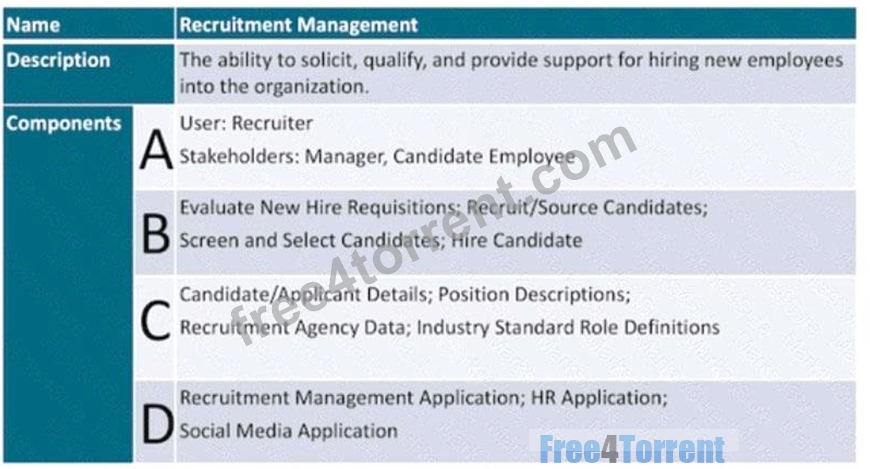
Which of the following are A and C?
- A. Actors, Actions.
- B. Roles, Information.
- C. Organization. Data.
- D. Who. What.
Answer: B
Explanation:
According to the TOGAF Business Capabilities Guide V2, a business capability is defined as "the expression or the articulation of the capacity, materials, and expertise an organization needs in order to perform core functions"5. A business capability can be decomposed into four elements: roles, information, processes, and technology5. In the given example, A represents roles and C represents information.
In the context provided in the image, 'A' refers to the roles involved in the recruitment management process, which in this case is the 'User: Recruiter' and the 'Stakeholders: Manager, Candidate Employee'. 'C' refers to the information or data aspects of the process, which includes 'Candidate/Applicant Details', 'Position Descriptions', 'Recruitment Agency Data', and 'Industry Standard Role Definitions'. Thus, 'A' corresponds to
'Roles' and 'C' to 'Information'.
https://pubs.opengroup.org/pocket-guides/togaf-pocket-guide/main/chap04.html
NEW QUESTION # 73
......
OGBA-101 Certification Overview Latest OGBA-101 PDF Dumps: https://braindumps.free4torrent.com/OGBA-101-valid-dumps-torrent.html