

The Best NCARB PDD Study Guides and Dumps of 2026
Top NCARB PDD Exam Audio Study Guide! Practice Questions Edition
NEW QUESTION # 33
A family-owned apple farm in the Upper Midwest is taking advantage of a change in the local zoning code that added a new Agri-Tourism class in the existing farm zone. This allows the Owner to build a new facility on their existing site. The building will be open to the public and include a brewery, distillery, tap room, and market. The architect is ready to submit the drawings to the Owner for the 50% construction documents review.
To accommodate a compressed construction schedule, the Owner will be utilizing a design-build process. The Contractor has submitted the Pre-Engineered Metal Building (PEMB) shop drawings to the Architect for review, due to the lead time on this critical path item. Once construction begins, farming operations must be able to continue uninterrupted.
Key project information includes:
* Brewing and distilling will operate year-round.
* Brewery will initially include four fermenting tanks. Owner has requested space for at least two additional tanks. Potential expansion will be based on future sales.
* Distillery will produce 16% alcohol, which is classified as a flammable liquid. Fire separations are required.
* Tap Room is designed with seating for 300 people, not including exterior patio seating. It will have views to the working orchards and the historic buildings on site.
* Tap Room is scheduled to be open from August through November. Owner would like options to extend operating dates based on popularity.
* The Market area will feature local farm products and is not conditioned.
* Entire building will be fully sprinklered.
* Selected building materials are low-maintenance, as requested by the Owner, for durability and to reflect the nature of a working farm.
* Mechanical and electrical systems will be hung from the building structure. These loads are included in PEMB shop drawings.
* Public water and sewer is not available at the Project Site.
* Occupancy sensors are included to reduce utility costs and achieve energy conservation requirements.
The following resources are available for your reference:
* Architectural Drawings, including plans, elevations, sections, and schedules
* Consultant Drawings, including structural, HVAC, power distribution, and plumbing
* PEMB Shop Drawings
* Design and Construction Schedule
* Specification Excerpts, showing relevant spec sections
* IBC and ADA Excerpts, showing relevant code and accessibility sections
* After reviewing the documents, the architect discovers a coordination issue in the corridor.
The owner has revised the pro forma and directed the architect to add two additional Type B units to the design. A code review for the project indicates that the building occupancy is R-2.
What should the architect do to meet the owner's required revisions?
- A. Change the 2nd Floor Unit 1BR-SW into two studios and change the 10th Floor Unit 2BR-E to two 1- bedroom units.
- B. Change the 10th Floor Unit 2BR-E to two 1-bedroom units and change the 7th Floor Unit 2BR-E to two
1-bedroom units. - C. Change the 5th Floor Unit 2BR-E to two 1-bedroom units and change the 2nd Floor Laundry to a 1- bedroom unit.
Answer: B
Explanation:
Converting two existing 2-bedroom units into two 1-bedroom units each yields two additional dwelling units total, while keeping every unit on an exterior wall for light/vent and maintaining typical plumbing stacks
/egress.
A introduces two studios (size/layout risk) and alters a lower-floor stack; more coordination risk.
C converts a Laundry (likely interior and serving the building) into a unit-problematic for light/ventilation and building services.
PDD refs: IBC R-2 unit planning, light/ventilation, egress; planning & stacking strategies to minimize rework.
NEW QUESTION # 34
Which of the following siding types should only be applied vertically?
- A. V-groove tongue and groove
- B. Board and batten
- C. V-shiplap
- D. Plain bevel
Answer: B
Explanation:
Board#and#batten is a vertical siding system: wide vertical boards with narrow battens covering the joints; its detailing, drainage, and expansion behavior are intended for vertical application only.
By contrast, plain bevel (lap) siding is typically horizontal; V#shiplap and V#groove T&G can be detailed either direction depending on manufacturer, but are commonly horizontal on walls.
PDD References: Exterior wall cladding and detailing under "Materials & Assemblies-Exterior enclosure," CSI Div. 06 & 07 application details.
NEW QUESTION # 35 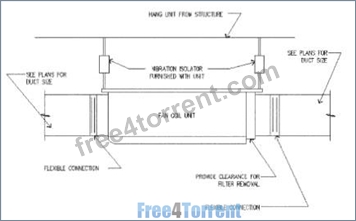
Refer to the exhibit.
What is the purpose of the flexible connection in the fan coil shown?
- A. To minimize sound transfer
- B. To insulate against heat transfer from the fan coil unit
- C. To provide a field point of connection of the ductwork to the fan coil unit
- D. To transition from the fan coil unit flange to the desired duct size
Answer: A
Explanation:
Understanding the Diagram
The detail shows a fan coil unit suspended from the structure, with:
* Vibration isolators at the hanging rods to limit mechanical vibration transfer to the structure.
* Flexible duct connections between the fan coil unit and the rigid ductwork.
Purpose of Flexible Duct Connections
Flexible connections in HVAC duct systems are designed to:
* Prevent transmission of vibration and sound from the mechanical equipment (fan coil unit) into the rigid ductwork and building.
* Compensate for small misalignments between the ductwork and equipment.
* Accommodate minor thermal expansion/contraction movements.
Key Function in This Context:
Fan coil units contain fans that create vibration and noise. Without a flexible connection, this vibration would travel directly through the rigid ductwork into occupied spaces, increasing noise levels.
Why Other Options Are Incorrect:
* A. To provide a field point of connection - While the flexible connector does connect ducts, its purpose is not just convenience; it is specifically for vibration/sound isolation.
* B. To insulate against heat transfer - This is done with thermal duct insulation, not flexible connectors.
* D. To transition from flange to desired duct size - Transitions are made using sheet metal fittings, not flexible connectors.
NCARB ARE 5.0 PDD Study Guide References:
* Content Area: Integration of Building Materials & Systems - Mechanical Systems and Acoustics
* Sources:
* Mechanical and Electrical Equipment for Buildings (MEEB) - Vibration Control in Mechanical Systems
* Architectural Graphic Standards - Flexible Duct Connections for Noise and Vibration Isolation
* ASHRAE Handbook - HVAC Applications, Chapter on Sound and Vibration Control Key Point:
Flexible connectors in ductwork break the direct mechanical path for vibration and sound, reducing noise transfer from fans to occupied areas.
NEW QUESTION # 36 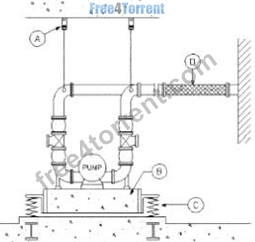
Refer to the exhibit.
Which device allows for piping misalignment and isolation?
- A. C
- B. A
- C. B
- D. D
Answer: D
Explanation:
Understanding the Diagram
The image shows a pump installation detail with various vibration and alignment control devices:
* A - Typically a pipe hanger or suspension support to reduce strain on piping.
* B - Likely a flexible electrical conduit (for pump motor connection).
* C - Spring vibration isolators under the pump base to prevent vibration transmission into the building structure.
* D - A flexible pipe connector (also called a flex connector or braided flexible coupling).
Purpose of Flexible Pipe Connectors
Flexible pipe connectors (D in the diagram) are designed to:
* Absorb minor misalignment between connected piping systems.
* Reduce stress on pump flanges due to thermal expansion, settlement, or installation tolerances.
* Isolate vibration from the pump so that it is not transmitted along rigid piping to the building structure.
This makes them essential in mechanical systems where pumps, chillers, or other vibrating equipment connect to rigid building piping.
Why Other Options Are Incorrect:
* A. Pipe hangers/supports - Maintain alignment and support vertical loads but do not allow for misalignment or vibration isolation in the same way as flexible connectors.
* B. Electrical conduit/flexible connection - Relates to electrical supply flexibility, not piping alignment.
* C. Spring vibration isolators - Isolate vibration from equipment to the floor but do not address piping misalignment.
NCARB ARE 5.0 PDD Study Guide References:
* Content Area: Integration of Building Materials & Systems - Mechanical Systems Coordination
* Source References:
* Mechanical and Electrical Equipment for Buildings (MEEB) - Chapter on Vibration Isolation & Pump Installation
* Architectural Graphic Standards - Flexible Connector & Piping Details
* Key Point: Flexible connectors at pumps and equipment protect against misalignment, vibration, and stress transfer to the piping system.
NEW QUESTION # 37 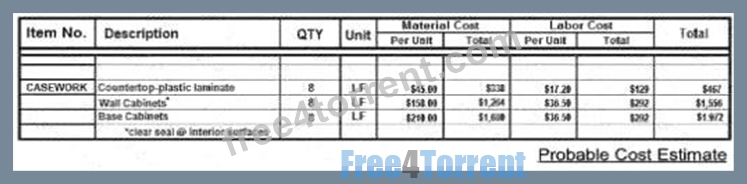
Refer to the exhibit.
Construction document drawings are in the final review stages. The architect needs to coordinate the casework detail with the probable cost estimate.
Click on the drawing note in the casework section that does not align with the cost estimate.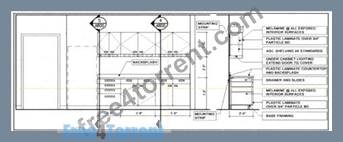
Answer:
Explanation: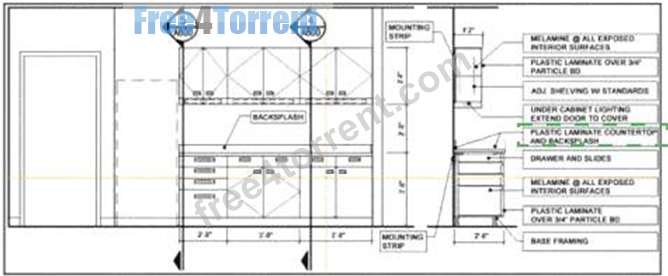
Explanation:
In the casework section drawing provided, the detail that likely does not align with the cost estimate is the note:
"PLASTIC LAMINATE COUNTERTOP AND BACKSPLASH"
This is often a higher-cost item compared to alternatives like post-formed countertops, solid surface over MDF, or budget composite finishes. If the project is under cost pressure, specifying both a plastic laminate countertop and a separate laminate backsplash can increase material and labor costs due to custom fabrication and edge treatments.
NEW QUESTION # 38
A family-owned apple farm in the Upper Midwest is taking advantage of a change in the local zoning code that added a new Agri-Tourism class in the existing farm zone. This allows the Owner to build a new facility on their existing site. The building will be open to the public and include a brewery, distillery, tap room, and market. The architect is ready to submit the drawings to the Owner for the 50% construction documents review.
To accommodate a compressed construction schedule, the Owner will be utilizing a design-build process. The Contractor has submitted the Pre-Engineered Metal Building (PEMB) shop drawings to the Architect for review, due to the lead time on this critical path item. Once construction begins, farming operations must be able to continue uninterrupted.
Key project information includes:
* Brewing and distilling will operate year-round.
* Brewery will initially include four fermenting tanks. Owner has requested space for at least two additional tanks. Potential expansion will be based on future sales.
* Distillery will produce 16% alcohol, which is classified as a flammable liquid. Fire separations are required.
* Tap Room is designed with seating for 300 people, not including exterior patio seating. It will have views to the working orchards and the historic buildings on site.
* Tap Room is scheduled to be open from August through November. Owner would like options to extend operating dates based on popularity.
* The Market area will feature local farm products and is not conditioned.
* Entire building will be fully sprinklered.
* Selected building materials are low-maintenance, as requested by the Owner, for durability and to reflect the nature of a working farm.
* Mechanical and electrical systems will be hung from the building structure. These loads are included in PEMB shop drawings.
* Public water and sewer is not available at the Project Site.
* Occupancy sensors are included to reduce utility costs and achieve energy conservation requirements.
The following resources are available for your reference:
* Architectural Drawings, including plans, elevations, sections, and schedules
* Consultant Drawings, including structural, HVAC, power distribution, and plumbing
* PEMB Shop Drawings
* Design and Construction Schedule
* Specification Excerpts, showing relevant spec sections
* IBC and ADA Excerpts, showing relevant code and accessibility sections
* After reviewing the documents, the architect discovers a coordination issue in the corridor.
The client wants to add rooftop access for residents. Roof access features include:
Adding a vegetated roof system
Installing an elevated paver patio system
Limiting access to 50 residents at any time
What should the architect do to accommodate this revision? Check the four that apply.
- A. Provide additional roof details
- B. Provide an exterior exit stair
- C. Consult structural engineer
- D. Consult elevator manufacturer
- E. Revise exterior elevations
- F. Contact civil engineer
Answer: A,B,C,E
Explanation:
Interpreting the Scenario
The owner is requesting rooftop access for residents, featuring a vegetated (green) roof, an elevated paver patio, and occupancy limited to 50 people. These revisions introduce new design requirements triggered by building codes (means of egress, structural loads, architectural representation) and coordination challenges across disciplines.
Why Each Selected Option is Required
* Revise Exterior Elevations
* The addition of a rooftop terrace and vegetated roof changes the building's exterior appearance- its massing, parapets, materials, and possibly guardrail heights. These design changes must be reflected in the architectural drawings used for permit issuance and construction.
* Provide an Exterior Exit Stair
* Under the International Building Code (IBC) and general egress requirements, an occupied rooftop (used by people for recreation or amenities) must be safely accessible and egressed.
Occupied roofs require a stairway-an exterior exit stair-rather than just a hatch or ladder ICC+6NYC+6The Building Code Forum+6NYC+4lapeyrestair.com+4NYC+4. This ensures the rooftop can serve as a legal means of egress.
* Provide Additional Roof Details
* Adding a vegetated roof system and a paver patio involves multiple layers (waterproofing, root barrier, drainage, structural substrate, pavers, possibly amenity loading, edge details, guardrails).
The project manual and construction documents must include these specific details to ensure proper assembly and water protection.
* Consult Structural Engineer
* Vegetated roofs and paver patios introduce significant dead loads (soil, plants, saturated weight) and live loads (maintenance personnel, occupants). The structure must be verified to support these loads. Per green roof design standards, structural capacity must be evaluated early in the design process NYC. Consulting the structural engineer ensures safety and code compliance.
Why Other Options Do Not Apply
* E. Consult elevator manufacturer
* There's no indication that elevator access is required or available. Current code triggers elevator access only in specific scenarios (e.g., occupant loads exceeding certain thresholds combined with accessibility requirements). This project doesn't suggest such a need.
* F. Contact civil engineer
* The rooftop change pertains to architectural detailing, structural capacity, and life safety-not site-wide civil issues like grading, stormwater, or utilities. While the vegetated roof may affect overall stormwater management, primary concerns still fall under architectural and structural domains. Typical ARE scope categories engage the geotech/environmental or landscape professional-not necessarily the civil engineer-unless broader site infrastructure is impacted.
NEW QUESTION # 39
During drawing review, a discrepancy is found between the drawings and room 101 on the finish schedule.
Click in the cell on the room finish schedule that does not match the drawings.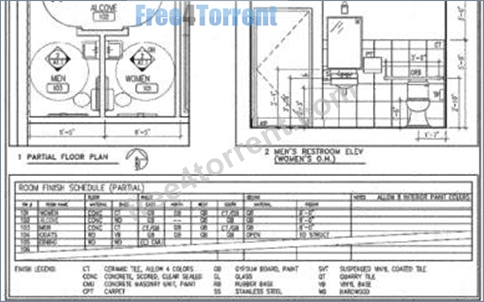
Answer:
Explanation: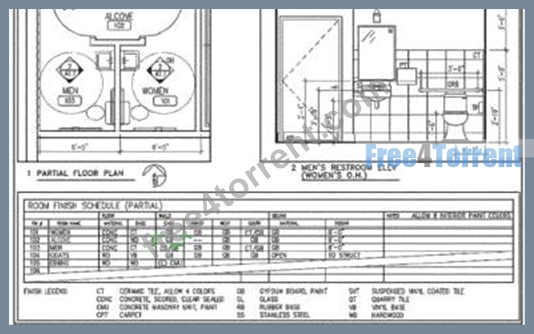
Explanation:
Generated image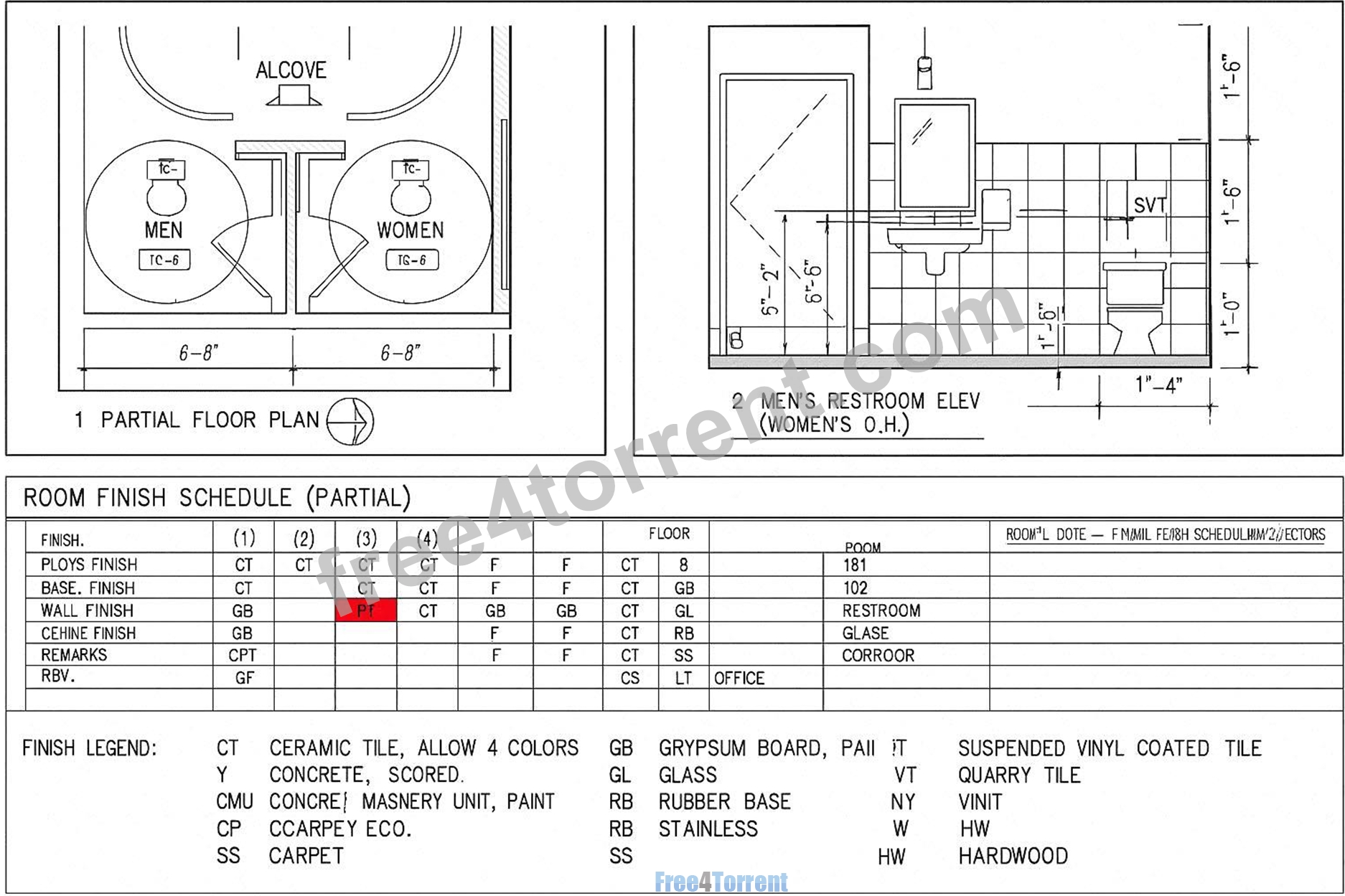
To identify the discrepancy between the drawings and the Room Finish Schedule for Room 101, compare what's shown in the restroom elevation and plan versus the listed finishes.
Step-by-step comparison:
* Room 101 (Women's Restroom) is shown with:
* Wall finish: Clearly shows tile (CT) on the lower half of the walls in the elevation.
* But in the finish schedule, Room 101 has "PT" (paint) listed under wall finish.
# Therefore, the error is in the wall finish cell for Room 101, which should show CT (ceramic tile), not PT (paint).
NEW QUESTION # 40
In which of the following locations in concrete masonry should a control joint be placed?
- A. At the first course of masonry walls
- B. At each corner of the foundation wall
- C. In the center of window openings
- D. At changes in wall height
Answer: D
Explanation:
Control joints in concrete masonry walls are designed to accommodate movement caused by thermal expansion, moisture changes, and settlement.
Control joints should be placed at locations of stress concentration, such as changes in wall height, changes in wall thickness, or at large wall expanses.
They are not placed at the first course of masonry (which is typically reinforced and anchored to the foundation).
They are generally not placed at window corners or in the center of window openings but rather at planned intervals or changes in geometry.
Placing a control joint at changes in wall height allows movement without cracking.
References:
NCARB ARE 5.0 Review Manual, Materials and Assemblies chapter
Masonry design and control joint placement per ASTM standards
Masonry construction manuals (e.g., NCMA TEK)
NEW QUESTION # 41 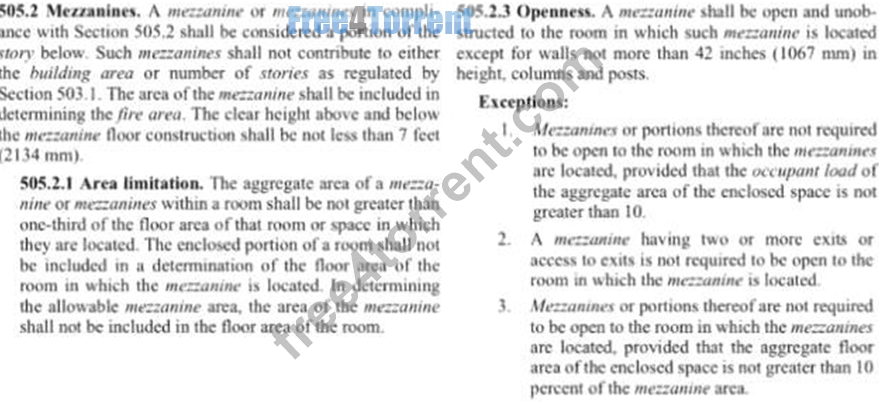
Refer to the exhibit.
An architect is working on an airport lounge project. The 9,000 SF floor plan includes an open, double-height space. Due to area limitations, all program requirements cannot fit within the 9,000 SF floor plan. A mezzanine level with one exit is being proposed to solve this programming constraint. There are adequate exits available on the main floor plan to pick up the additional occupant load from the mezzanine.
Which method of mezzanine construction should the architect design?
- A. 2,500 SF open lounge area for 20 people
- B. 2,750 SF enclosed business center for 15 people
- C. 3,250 SF open dining area for 30 people
Answer: B
Explanation:
Step-by-Step Reasoning
1. Mezzanine Area Limitations - IBC Section 505.2.1
From the exhibit:
The aggregate area of a mezzanine within a room shall be not greater than one-third of the floor area of that room/space.
Given:
* Main floor = 9,000 SF
* Maximum mezzanine size = 1/3 × 9,000 SF = 3,000 SF
2. Openness Requirements - IBC Section 505.2.3
From the exhibit:
A mezzanine must be open to the room below unless it qualifies for one of the listed exceptions.
3. Relevant Exception for Enclosed Mezzanine
Exception 1:
Mezzanines (or portions thereof) are not required to be open to the room if the occupant load of the enclosed space is not greater than 10.
Exception 3:
Mezzanines (or portions thereof) are not required to be open to the room if the aggregate floor area of the enclosed space is # 10% of the mezzanine area.
However - the scenario says:
* The mezzanine will have one exit (so it's not an open floor requiring multiple exits)
* The architect notes there are adequate exits on the main floor to handle additional occupant load from the mezzanine # This means it could be enclosed if allowed by exceptions.
4. Evaluate Each Option:
* A. 2,500 SF open lounge for 20 people
* Size < 3,000 SF # OK on area.
* Open mezzanine # Complies without needing an exception.
* But 20 occupants means more than 10 occupant load, so it can't be enclosed unless open - this one is already open, so fine.
* This works, but the question asks for which method should the architect design, and the key is the one-exit enclosed scenario.
* B. 2,750 SF enclosed business center for 15 people
* Size < 3,000 SF # OK.
* It is enclosed, and occupant load is 15, which is greater than 10. That means Exception 1 doesn't apply.
* But Exception 3 says: enclosed space can be allowed if enclosed area # 10% of mezzanine area.
Here:
* 10% of 2,750 SF = 275 SF.
* If the enclosed portion is the business center itself (full area enclosed), then it fails Exception 3.
* Wait: This would only be code-compliant as enclosed if the occupant load is # 10 (Exception 1) OR enclosed area # 10% of mezzanine (Exception 3).
* This option might work only if the mezzanine is considered enclosed but the occupant load doesn' t require multiple exits and is allowed due to adequate exit capacity on the main floor - this appears to be the intended IBC Exception 1 scenario, but since OL = 15 > 10, it technically fails Exception 1.
* The problem statement says "adequate exits available on main floor to pick up additional occupant load" - which would allow designing an enclosed mezzanine as long as total egress capacity is fine.
* C. 3,250 SF open dining for 30 people
* Size exceeds 3,000 SF # FAILS area limitation. Not allowed.
5. Conclusion
Given the constraints:
* Must fit within 1/3 floor area rule (# 3,000 SF)
* Must work with one exit and available exit capacity on main floor
* Option C fails on size
* Option A is possible but doesn't use the enclosed condition in the prompt
* Option B meets area limit, occupant load works with available exit capacity, and provides an enclosed use that matches the problem's "program requirement" scenario
NEW QUESTION # 42 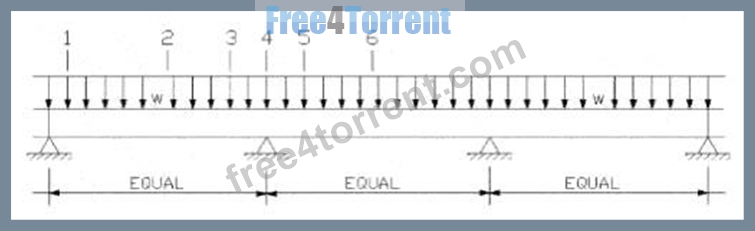
Refer to the exhibit.
It is required to cut a hole in the web of the beam shown.
Which of the locations would be best? Check the two that apply.
- A. Location 1
- B. Location 5
- C. Location 4
- D. Location 3
- E. Location 2
Answer: C,E
Explanation:
Cutting holes in beam webs is common for running mechanical, electrical, or plumbing services but must be done carefully to avoid weakening structural integrity.
Holes should be located near mid-span supports (points of low bending moment and high shear) to reduce impact on beam bending strength.
Holes should not be located near areas of maximum bending moment (typically mid-span between supports), because this is where the beam experiences maximum tension or compression.
Locations 2 and 4 are at or near the beam supports (shear zones), and generally small holes can be cut there, following size limits and reinforcement guidelines.
Locations 1, 3, and 5 are closer to mid-span or areas of high bending stress, so holes here risk compromising the beam's moment capacity.
References:
NCARB ARE 5.0 Review Manual, Structural Systems chapter
Steel construction and beam design guidelines (AISC)
Building codes and structural engineering best practices for web penetrations
NEW QUESTION # 43 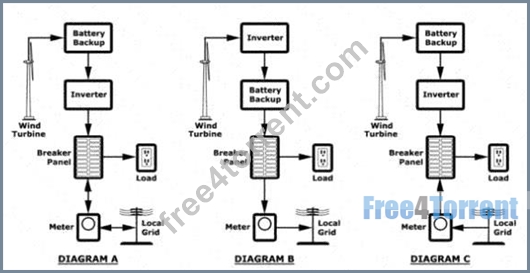
Refer to the exhibit.
An architect is developing an electrical diagram to show equipment configuration and flow of electricity for a residential project. The project is integrating on-site wind generation where the utility company does not allow net metering.
Which diagram meets the project requirements?
- A. Diagram A
- B. Diagram C
- C. Diagram B
Answer: B
NEW QUESTION # 44 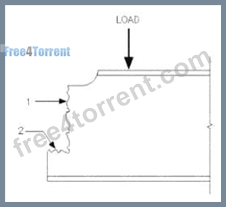
Refer to the exhibit.
Which of the following correctly identifies the types of failures indicated in the beam diagram?
- A. Tension, Compression
- B. Compression, Shear
- C. Shear, Tension
- D. Shear, Compression
Answer: C
Explanation:
The diagram shows a loaded beam with two types of failure indicated:
Location 1 on the top edge shows shear failure - characterized by jagged cracks or fractures, typically near supports or where shear forces peak.
Location 2 near the bottom edge shows tension failure - concrete is weak in tension, so cracks develop at the bottom face in a simply supported beam under load.
This matches common structural behavior where:
The top fibers of a beam in bending undergo compression and shear stress.
The bottom fibers undergo tension (where cracks often form).
Shear cracks are usually diagonal and closer to the support (near the ends), tension cracks are vertical and near the midspan.
Reference:
NCARB ARE 5.0 Review Manual, Structural Systems chapter
Fundamentals of structural analysis and beam failure modes
NEW QUESTION # 45
In the critical path method of scheduling for new construction, the site work portion is always on the critical path due to which of the following?
- A. Site work must be completed linearly.
- B. Retainage for site work is held until the end of the project.
- C. Site work is dependent upon short interval scheduling.
- D. Site cost is usually a high percentage of the total work.
Answer: A
Explanation:
In the Critical Path Method (CPM) scheduling, the critical path is the longest sequence of dependent activities that determines the project duration.
Site work typically involves grading, excavation, underground utilities, and foundation preparation.
Site work must proceed in a linear, sequential manner: earthwork must finish before foundation pours; utilities are installed before slabs.
These activities are dependent on each other and cannot be done in parallel or out of order.
Therefore, site work forms a continuous chain of dependent activities on the critical path.
Other options are less relevant to CPM critical path logic:
Site work costs or retainage do not influence CPM scheduling.
Short interval scheduling is a project control technique, not a CPM determinant.
Reference:
NCARB ARE 5.0 Review Manual, Project Management and Scheduling chapter
CPM scheduling principles from project management texts like PMBOK or Construction Planning and Scheduling by Jimmie Hinze
NEW QUESTION # 46
Where is the proper place to put a vapor barrier in a cold climate?
- A. On the interior between the gypsum wallboard and the framing
- B. On the exterior between the metal siding and the sheathing
- C. In the cavity of the framing space
- D. On the exterior between the framing and the sheathing
Answer: A
Explanation:
In cold climates, the vapor drive is from the warm interior to the cold exterior during winter. The vapor retarder/barrier belongs on the warm-in-winter side of the assembly-i.e., behind the interior gypsum, before the framing/insulation-to prevent interior moisture from reaching cold layers where it could condense.
PDD references: Psychrometrics & vapor drive; vapor retarder placement (ASHRAE; IBC/IECC guidance; ARE 5.0 PDD-Thermal & Moisture Protection).
NEW QUESTION # 47 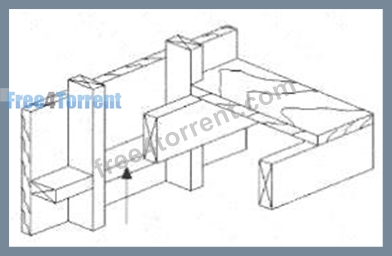
Refer to the exhibit.
What is the horizontal member indicated by the arrow in the wall-floor assembly?
- A. Lateral shear plate
- B. Girt
- C. Ledger
- D. Fire block
Answer: C
Explanation:
The arrow in the wall-floor assembly indicates a horizontal structural member attached to a wall, used to support the end of a floor joist. This is called a ledger.
Ledger: Typically a dimensional lumber or engineered wood member fastened to a wall that supports floor framing members (joists).
Fire block: Installed to limit fire spread in concealed spaces-often mid-wall or mid-stud cavity, not in this floor-to-wall position.
Girt: A horizontal framing member in a wall, usually in steel-frame or post-frame construction, not in conventional wood framing for floors.
Lateral shear plate: A metal plate for shear transfer, not applicable here.
PDD References:
ARE 5.0 PDD "Structural Systems-Wood framing details"
IBC §2308.4-Floor framing requirements
AWC (American Wood Council) "Wood Frame Construction Manual" Ledger attachment details
NEW QUESTION # 48
An architect is rehabilitating a historic federal landmark that requires repairs to a garden wall. The existing brick appears to be in good condition; the mortar shows significant signs of deterioration.
Which strategy should the architect propose to repair the damaged wall?
- A. Completely remove deteriorated mortar with electric saws prior to repointing.
- B. Remove loose mortar by hand raking the joints prior to repointing.
- C. Carefully remove all mortar and repoint all joints to achieve a uniform appearance.
Answer: B
Explanation:
(PDD) Study Guide References
For historic masonry rehabilitation, the accepted approach (e.g., NPS Preservation Brief 2: Repointing Mortar Joints in Historic Masonry) is to hand#rake deteriorated mortar to a proper depth (typically 2-2½× the joint width or until sound mortar is reached), avoid power#saw removal that can damage historic brick, and match the original mortar in composition, hardness, color, and tooling.
A is incorrect because removing all mortar for a "uniform appearance" is unnecessary and risks damaging sound joints.
B is incorrect because electric saws can chip and over#cut historic brick arrises, violating preservation best practices.
C is correct: careful hand removal of loose/deteriorated mortar followed by repointing with compatible mortar is the recommended method.
PDD References: Historic fabric protection under "Codes/Regulations & Standards-Historic preservation," detailing of masonry repairs in construction documents (Division 04), and QA/QC specifications for repointing.
NEW QUESTION # 49
Why is the vertical surface of a dry-stacked stone wall often battered into the retained material?
- A. Increased resistance to surface erosion of the wall
- B. Increased resistance to soil thrust
- C. Increased cohesion between individual stones that make up the wall
- D. Increased impermeability that reduces equivalent fluid pressure
Answer: B
Explanation:
A battered (leaning back) face on a dry-stacked retaining wall improves stability against lateral earth pressure by shifting the wall's resultant closer to/within the middle third of the base, increasing frictional resistance and reducing overturning. It does not significantly change permeability (C) or directly increase cohesion between stones (D), and erosion resistance (B) is secondary compared to stability.
PDD References: Site & foundation systems-retaining wall behavior, active/passive earth pressures; IBC
/Geotechnical fundamentals; CSI Div. 32 site improvements.
NEW QUESTION # 50
......
Valid PDD Exam Updates - 2026 Study Guide: https://braindumps.free4torrent.com/PDD-valid-dumps-torrent.html